It is said that without work, nothing goes forward. The statement, of course, is obviously correct anyway you may wish to put it. Without people working in the fields, we’d have no crops to both grow and collect. Without people working in fishing, you’d have no fish in your supermarkets. With no teachers, or at least even an educational tutor of sorts, you would not have the ability to teach and learn. All these are just a few examples of crucial jobs that are required for the functioning of a society and/or community. But, what if these jobs were treated with scorn or with little attention? What if the people working at them do not get paid, either much or nothing at all? If they were forced to work extended periods of time with no respite in dangerous conditions? Not only would such dissuade people from looking for employment in such sectors, therefore running the risk of a crisis due to a lack of employees, but much more: it could also bring in people who are so desperate for an income that they are working on the edge of indentured servitude, Gang mastering, and straight up illegal hiring, with few rights to their name. Luckily enough, there are laws in place all around the world put up to stop this from happening. However, what is written on paper does not always translate to success in practice. Within the European Union, known for its labour laws and their ability to change labour policies throughout its Member States, this too unfortunately happens.
A basic look at EU labour laws
Learning about the European Union’s labour laws is not too difficult, and is rather straightforward. Covering two many areas, that of working conditions and consulting with workers and their representatives, it looks rather basic in principle. However, due to the varied nature of the European Union, being somewhere in between a Supranational Union and a Union of Nation States, labour laws and policies can and will be different among different countries. With that being said, they all follow the common thread of being placed within the line of EU labour laws that are promulgated by its central administrative systems. After all, once a new policy or legislation is approved by the EU, each country is obliged to implement and to enforce it, ensuring its existence is not just in theory but in practice as well.
So there can be differences in some places, in regards to timetabling (in Italy, for example, Monday is seen as the day of rest during the week for many businesses, with many of them being closed, unlike other countries where on Sunday everything remains closed), pay checks, and wages. For example, the European Union labour law does not cover wage regulation, i.e. deciding what ought to be the right price for the work done, leaving such decisions to each Member States. This is one of many of clear examples where one can see differences among salaries in different European Union countries: even the Irish minimum wage is much higher than an average wage in countries such as Italy (which lacks a minimum wage altogether).
Nonetheless, however, such shouldn’t imply that the European Union just goes straight for a laissez-faire system for how each country treats its workers and the various labour markets. Achieving high employment and a robust social protection scheme are cornerstones of EU labour laws, and easily intertwine with the wider concept of the European social model, a highly valued concept that finds attraction both within Member States and those who aspire to join the Union. The European Union ensures that its workers get their rights respected, without fear of abuse, overworking or dangers, applying this to all, regardless of their ethnicity, gender, language, working part-time or full time.
How are they enforced?
Back in 2016, the European Union created the “European centre of expertise”, whose goal is to cover the regulation, policy, legality and economy of employment within the 27 Member States. Regarding labour laws, this implies the centre’s duty of aiding the Commission in ensuring a proper application of an EU law, anticipating potential issues from them and improving public awareness of the implemented laws. This is not the only way for the Union to ensure the Labour laws are enforced. Perhaps expectedly, the European Court of Justice has much influence as oftentimes National courts will refer a problem regarding work to the CJEU, which gives its an answer to solve the problem within the parameters of EU labour law. Overall however it is the Commission itself that constantly checks that every EU country properly implements the labour laws not just on paper, but in practice as well. This ensures that every worker in the EU gets a degree of work safety and stability as their lives get to be looked after as they do what they need to do in order to get their salaries.
And these are not the only ones. In 2019 the European Labour Authority was founded, with its main goal within the framework of European Union labour policies being to ensure that labour mobility (a huge matter in European Union ideals, revolving around the free movement of people) and social security were properly enforced in the most effective manner possible. Once again, the avenues used by the European Union to monitor the efficacy, efficiency and implementation of are many, clearly showing the extent of how important workers’ safeties and securities are.
Workplace accidents: a grim reality
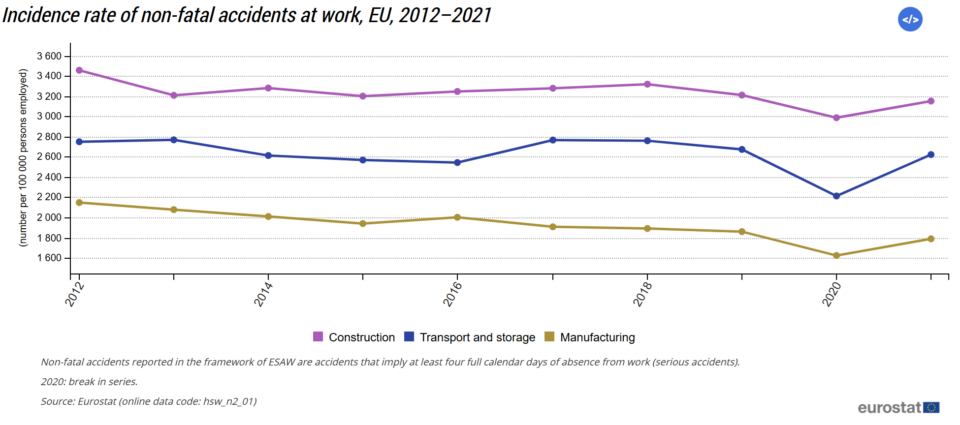
Unfortunately despite such good intentions and laws, the fact of the matter still remains that far too many people risk and lose their lives in Europe while working under dangerous, often illegal, conditions. As the image above clearly shows, such accidents have began climbing again in 2021 after plateauing and even going down in 2020. Rather unsurprisingly, unfortunately, the Construction sector (despite not having the same numbers as back in 2012) is the most affected; as construction workers have to endure dangerous conditions with not the biggest pay to make up for it, it is no wonder that this is one of the many sectors that suffers from a manpower shortage as mentioned earlier in this blog post. These also show the incident rate of non-fatal accidents, but fatal accidents do happen often, and they can be brutal.
Recently in Italy where I currently reside there had been a horrifying case of a worker called Satnam Singh who died not far from Rome. He had been gravely wounded in an accident while working in the nearby fields: a harvesting machine broke his legs and cut one of his arms off while gathering melons. His employer took him away from the fields and dumped him in front of his house with his arm placed in a box. He died two days later after he had been brought to the hospital. Doctors said that his injuries were treatable had he been brought immediately from the fields to them. Satnam Singh was working under illegal conditions, unregulated and constantly abused on a daily basis. Despite not being a Member State citizen, European Union laws can and do extend to non-EU workers (with or without work visas), but such rules had been ignored and he suffered for it. The man joined a list of names, far too many names, of people who had died or hugely injured due to poor work security and regulations, ignored one too many times either because they were illegal, or because spending money to provide better security was not an expense employers were willing to take. The set of rules promulgated by the European Union had not been enforced and it took away a man’s life. This is not the first time, and I fear that it will not be the last either, nor will much time pass until a situation like his reaches the ears of all.
Conclusion
The European Union labour laws are straightforward, yet at the same time not as simple to ensure their existence in practice as accidents and death still happen despite the big commitment to guarantee workers’ safety. They are a crucial part of Europe’s existence and I frankly could not imagine how dangerous the labour market could be without these rules and regulations putting them in line in a humane manner. But as long as there are people who get paid poorly, abused, mistreated and wounded at work then the whole Continent has much yet to learn in order to not fail itself and the people that make part of it. One can only hope that things may improve, that lessons are learned from mistakes made. The road ahead is a long one, but one can argue that Europe clearly and evidently has the capacity of treating its inhabitants with a respect rarely found elsewhere. Hopefully future strengthening of the EU labour laws will prevent the further erosion of workers’ rights and dignities and take steps forward into areas it has not yet explored. I will be looking closely at any related future updates on the matter from the European Union’s decision making, as for sure this is a contemporary subject that will be constantly subject to changes of all kinds. Thank you for reading. If you wish to learn more, you can look at the websites I explored whilst writing this post, and let me know what you think of as well, I’d be interested in hearing your opinions about how the European Union labour laws work and how they fare once put into practice. Thank you once again, and have a lovely day!
-€